The hunger strike is now entering its fifth week. I'm still on vacation, but didn't want this day to pass without pointing out Jeffrey Beard's take on the strike:
We are talking about convicted murderers who are putting lives at risk to advance their own agenda of violence.
Here's Dan Walters' commentary.
There are also some important statements on this Facebook page to counter Beard's commentary. I reproduce verbatim Tom Ammiano's:
I have read Secretary Beard’s claims in the LA Times and I have visited the SHU. On the one hand, the CDCR told me its isolation policies have put a stranglehold on gang leaders’ control. On the other hand, now they say gang leaders are calling the shots in the hunger strike despite their isolation. Which is it? They told us everyone in the SHU was a validated gang member, but when they reviewed cases, they cleared scores of prisoners of gang affiliation. We find it difficult to take CDCR’s claims about the hunger strike at face value. It would be easier to know if prison media access policies were better, as would have been the case under my bill vetoed by the Governor last year. Even so, one thing is clear: The isolation policies are of dubious benefit and they are an international embarrassment. I realize these prisoners have been convicted of terrible things, but I don’t have to believe everything they say to know that we must change our correctional practices. Taxpayers should not be funding indefinite isolation that is condemned in other countries as a human rights abuse.
Wednesday, August 7, 2013


Monday, August 5, 2013
Hunger Strike, Day 28: CDCR Mediating with Hunger Strike Representatives
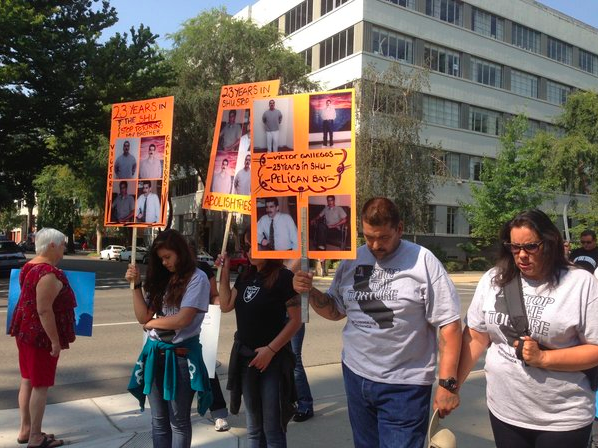 |
| Hunger strike supporters in Sacramento. Photo credit: Melanie Mason for the Los Angeles Times. |
California's prisons chief has agreed to meet for the first time with advocates for inmates who are in their fourth week of a hunger strike over conditions in solitary confinement.
"It's progress," said Ron Ahnen, president of the Oakland-based group California Prison Focus, which publishes a newsletter circulated to thousands of state inmates that hunger strike organizers used to broadcast their protest.
Ahnen is among a small group of activists set to meet Friday with Jeffrey Beard, Gov. Jerry Brown's appointed head of the Department of Corrections and Rehabilitation. Other expected attendees include a representative from the American Friends Service Committee.
Meanwhile, an interesting Bloomberg piece by Steven Greenhut compares Brown's we-don't-have-a-prison-crisis stance to George Wallace's resistance to school desegregation.
Jerry Brown, the quirky progressive governor, is defying the orders of three liberal federal judges to release thousands of criminals from the state’s prison system in order to relieve chronic overcrowding. The rhetoric is growing more heated as the state defies a special judicial panel that last week rejected the governor’s attempt to delay the releases and used harsh language in doing so: “Despite our repeated efforts to assist defendants to comply with our Population Reduction Order, they have consistently engaged in conduct designed to frustrate those efforts.”
In picking up the states’ rights banner, Brown finds himself being compared to Alabama’s segregationist governor, George Wallace, who in 1963 defied a federal order to desegregate the state’s schools. But some see Brown as a hero.
In California, the federal government might order marshals to open the cell doors and Brown could stand in a cell, argued Los Angeles Times columnist George Skelton. “Wallace was shamefully standing in the schoolhouse door trying to protect a university’s bigotry from integration by black students,” Skelton wrote. “Brown would be heroically protecting citizens from thugs.”
_______________________________
Props to Caitlin Henry for both links.
Sunday, August 4, 2013
CCC Field Trip: Wrongful Convictions in Ecuador (and, SCOTUS tells Jerry off)
By now, many readers have already heard the news: Gov. Brown's plea to modify the release plan and avoid releasing 10,000 inmates per the Plata mandate has failed in the Supreme Court. Justice Kennedy authored the decision. Law enforcement is already grumbling.
I'm on Quito, Ecuador, on vacation and don't want to get aggravated, so if you like, go read Scalia's dissenting opinion for yourselves.
Quito is a beautiful high-altitude city in the shadow of Mount Pichincha, with amazing art, colonial architecture, and marvelous parks. And, of course, as one does, the first thing I did this morning was read the local paper, El Comercio, which featured this amazing story about a wrongfully convicted man and his post-exoneration life.
Here's the bit that caught my eye:
Según datos de la Defensoría Pública, el 65% de personas apresadas recuperó su libertad porque no se hallaron pruebas en su contra. Estos datos fueron levantados desde el 2007 hasta el 2010.
(According to data from the Public Defender, 65% of arrested people were freed because there was no proof against them. These data was collected between 2007 and 2010. My translation--H.A.)
In fact, the article notes that wrongful convictions are so common that the Public Defender's office has a psychological department dedicated to help exonerated people deal with the stigma and reclaim their lives.
Expect more reports on the Ecuadorian justice system.
Tuesday, July 30, 2013
Day 23 of the Hunger Strike: Light and Shadow in Press Coverage
Two interesting newspaper articles came out recently, bracketing the range of public opinion about the California inmate hunger strike.
The first piece, in the Los Angeles Times, is a profile of Todd Ashker, one of the leaders of the hunger strike, part of the Short Corridor collective, described by the article as the "legal mind" behind the strike. Ahsker's long and violent criminal record and his membership in the infamous Aryan Brotherhood are examined at length, as is the stabbing of his defense attorney during his trial.
Armed with a prison law library and a paralegal degree earned behind bars, Ashker, 50, has filed or been party to 55 federal lawsuits against the California prison system since 1987, winning the right for inmates to order books and collect interest on prison savings accounts.
"There's an element within [the Department of Corrections] who would celebrate some of our deaths with a party," Ashker wrote to The Times in March after prison officials denied access to him.
But others say Ashker is a danger, accusing him of being an Aryan Brotherhood member bent on freeing gang leaders from solitary confinement so they can regain their grip on the prison system.
"We're talking about somebody who is very, very dangerous … who has killed somebody in a pre-meditated way," said Philip Cozens, Ashker's court-appointed defense lawyer in a 1990 murder trial.
Terri McDonald, who ran California's 33 prisons until a few months ago and now runs the Los Angeles County jail system, said Ashker and his compatriots in the Short Corridor Collective are not fighting for rights, but power.
"From my perspective, they are terrorists," she said.
Ashker has spent nearly all his adult life in California's prison system — and much of that time, he has been in solitary confinement.
Ashker has an intimidating record, indeed, and an unappetizing gang affiliation. But that is how someone ends up in isolation in Pelican Bay or in Corcoran: By committing crime and by being classified as a gang member. The question readers might want to ask themselves is, are we prepared for the moral slippery slope that starts with treating folks like Ashker as not human, and not deserving of basic dignity?
I've posted before about why I consider myself a left realist, rather than a radical abolitionist. I don't care for incessant recitations of the prison industrial complex mantra (frankly, I find this a useless argument with middle-class taxpayers), and I don't think that all prisoners are political prisoners. And I do think that some folks need to be in prison, for long periods of time, and perhaps Todd Ashker is one of them. I do, however, think that far less people should be incarcerated, and that holding 80,000 people nationwide under conditions that do not befit living human beings, depriving them of all human contact and offering inappropriate ways out, is categorically outrageous, no matter what crimes they perpetuated.
I am, apparently, not alone: Today's San Francisco Chronicle story lists many thinkers, actors, and political figures, including Jay Leno, Gloria Steinem, Bonnie Raitt, Peter Coyote, and Noam Chomsky, who oppose solitary confinement and support the hunger strikers.
This is the third hunger strike launched since 2011 to protest living conditions in the prison's security housing units, where 4,500 gang members, gang associates and serious offenders are held in extreme isolation, many of them for indeterminate terms of more than 10 years.
The protesters are demanding an end to indeterminate sentences and for alternative ways to leave the units other than "debriefing," which the prisoners say is an agreement to inform on gang members and a risk to their safety from reprisals for "snitching."
The security housing units at Pelican Bay Prison in Northern California are the subject of a lawsuit alleging that the living conditions — which include confinement to the cells for 23 hours a day and very little contact with other people — amounts to cruel and unusual punishment.
Maybe this support of the hunger strikers will convey the message that even inmates who commit truly heinous crimes are still human beings, and that cruelty and indignity cannot be justified as being begotten by cruelty and indignity.
---------------
Thanks to Tom Oster and to David Takacs for the links.
Monday, July 29, 2013
The Inmate as Customer: "Pay-To-Stay" and the Commodification of Punishment
This morning Huffington's Post reports about the Fremont Jail:
The Fremont Police Department is now offering its inmates a "pay to stay" option. For a one-time fee of $45 plus $155 a night, prisoners serving short sentences on lesser charges can stay in a smaller facility while avoiding county jails.
"It's still a jail; there's no special treatment," Lt. Mark Devine, a Fremont police official who oversees the program, told Chris De Benedetti of the Argus. "They get the same cot, blanket and food as anybody in the county jail, except that our jail is smaller, quieter and away from the county jail population."
This arrangement differs somewhat from the previously covered arrangement at the Riverside Jail: payment is not for basic incarceration, but for upgraded, improved services. The concerns raised by the ACLU are that the prison experience is likely to be tiered across race and class lines. But I think this is part of a larger humonetarian trend: The commodification of the prison experience and seeing the inmate as customer. Not the customer's-always-right from the early days of the service industry, but the customer-as-mass-consumer of the conglomerate era. It's no wonder inmates review prisons on Yelp.
Sunday, July 28, 2013
Hunger Strike Bears Fruit at Martinez Detention Facility
On July 19, 2013, all Martinez Detention Facility hunger strikers suspended their hunger strike. (Prisoners there had joined the statewide California hunger strike when it began on July 8, after submitting their own demands to the warden.) The SF Bay View reports about the demands that have been met, which were detailed explanations about reasons for administrative segregation, the ability to empty one's trash once a day, more privacy scheduling medical appointments (rather than announcing them on the intercom), separating mentally ill inmates from the general population, and allowing ink pen fillers to be purchased from the canteen.
Congratulations to the strikers on the successful conclusion of their courageous struggle, and best wishes to those who are still on hunger strike.
------
Props to Caitlin Henry for the link.
Congratulations to the strikers on the successful conclusion of their courageous struggle, and best wishes to those who are still on hunger strike.
------
Props to Caitlin Henry for the link.
Crime, Incarceration, and the Human Spirit: On Billy Sell and the Escape from Alcatraz
 |
| Frank Morris, Clarence Anglin, and John Anglin, courtesy the BBC UK. |
I wonder how much coverage Sell's death will receive in the mainstream media. Any effort to honor and remember his honorable sacrifice in the struggle for better incarceration conditions is likely to be blighted by ignorant commentary negating its value because, after all, he was doing time in prison, and therefore he must have been a very bad person, or worse, not a person at all. This is the same pervasive thinking that leads people on the outside to think that inmates are somewhat coddled by what folks who are not in the know perceive as "free health care." This dehumanizing attitude means not only that people can be disinclined to stand side by side with the hunger strikers and demand better conditions for them, but also that they could completely miss the heroic aspect of the struggle and not find anything admirable in it.
The tragic news of Sell's passing were particularly poignant for me yesterday, as I received them after completing my sixth successful Alcatraz crossing, which made me think about sacrifice and heroism within walls. Every time I jump off the ferry near Alcatraz and start swimming toward San Francisco I take a few moments to look behind my shoulder. In the first ten minutes of the swim it seems as if The Rock is not getting any smaller. And then, I think about the many documented attempted escapes from Alcatraz, and particularly about Frank Morris, John Anglin, and Clarence Anglin, who in 1961 plotted (with Allen West, who could not join them due to technical difficulties) the most daring, and likely successful, escape through the ventilation ducts, ingeniously using dummies and a raft.
More than fifty years after the escape, the file remains open, and among the thousands of athletes who attempt Alcatraz crossings there are many, like yours truly, who are convinced that Morris and the Anglin brothers made it safely to shore. I like to think of them, now very old men, sitting in a suit and a beret or a fedora at a cafe in North Beach, sipping a strong espresso, reading the Chronicle and chuckling quietly to themselves.
To them, the frustration of looking back and seeing The Rock looming dark and threatening must have been fraught with terrible fear and apprehension, compounded by the serious concerns about their welfare once they got to shore. Would they suffer hypothermia? Who would help and shelter them on the outside? Where would they get money, and how could they avoid being recaptured?
Time has been kind to Morris and the Anglin brothers. Millions around the world admire and respect their courage, ingenuity and bravery. But they were not saints. Morris' record included daring robberies, and the Anglin brothers robbed a bank (with a toy gun.) They received lengthy sentences and perhaps, to the average citizen in the early 1960s, would appear unsympathetic, dangerous, and undeserving of respect. Just as some people may be thinking about today's hunger strikers and their struggle.
But crime and criminality do not negate the value of the human spirit, or its ability to soar in courage and conviction. Last week many of us saw Fruitvale Station in the theaters and enjoyed Michael Jordan's humanizing rendition of Oscar Grant, a man who did not live a grand life of achievement, but rather a life of fatherhood, flawed partnership, and teetering between drug dealing and an honest day's work. And we cried for him, and we appreciated the ember of humanity within his soul, because it is also in ours, and we wept when that ember was extinguished by a gunshot. Billy Sell's death teaches us a related, and perhaps more important, lesson. It's not just that each and every life is precious and imbued with intrinsic value. It's also that the human spirit does not die if someone has broken the law. Indomitable courage, initiative, creativity, commitment to one's values, perseverance, and the yearning for personal freedom, are as admirable in prison as they are on a freedom ride or at a protest in the park, and perhaps more so because of the risk of retaliation and mistreatment, not to mention death. There are courage and bravery and principled positions behind walls. There is much there that we can find inspiring and respectable, even as there is plenty there (as on the outside) that we would find petty and deplorable.
May Billy "Guero" Sell's memory not be in vain, and as generations of athletes are inspired by Frank Morris and the Anglin brothers, may generations of activists and advocates within walls and on the outside honor his sacrifice with an undying struggle for dignity.
-----------
Props to Jonathan Simon, whose conversations with me last year inspired this post, to Caitlin Henry, whose work on behalf of the strikers inspires me daily, and to Chad Goerzen and Rhett Aultman for talking to me yesterday about Alcatraz and the power of myth.
Subscribe to:
Posts (Atom)